Why Should Your Business Use Affiliate Marketing Software?
Affiliate marketing software helps businesses organize partner relationships, track affiliate-generated activity, and manage campaign operations. By centralizing relevant information, it can reduce manual administration and make it easier to understand how affiliate partnerships contribute to business results.
The value depends on the platform’s capabilities, the quality of its integrations, and how the affiliate program is managed. For businesses working with multiple affiliates, campaigns, or commission arrangements, dedicated software can provide a more consistent way to coordinate activity and evaluate performance.
Key Benefits of Affiliate Marketing Software
Affiliate marketing software can help businesses address several common operational challenges:
1. Centralized program management
Managing affiliate details, offers, tracking links, and commission arrangements across separate systems can create unnecessary work. A dedicated platform can bring these workflows together, helping teams organize information and maintain consistent program processes.
2. Better visibility into campaign performance
Tracking and reporting tools help businesses analyze clicks, conversions, attributed revenue, commissions, and other relevant metrics. Teams can use these insights to identify productive partnerships, investigate changes in performance, and decide where further optimization may be worthwhile.
3. More efficient administration
Depending on the platform, automation can support tasks such as conversion validation, commission calculations, offer management, and reporting. Reducing repetitive manual work can free teams to focus more on partner relationships and campaign development.
4. Improved monitoring and control
Access permissions, configurable validation rules, and suspicious-activity alerts can help teams monitor affiliate activity and investigate potential problems. These controls vary by provider and require appropriate configuration; they do not guarantee that every fraudulent transaction will be detected.
Which Industries Use Affiliate Marketing Software?
Affiliate marketing software can support different business models, but the workflows and features required vary by industry.
| Industry |
Common affiliate marketing use cases |
| Ecommerce and retail |
Tracking orders, managing product promotions, and calculating commissions on eligible sales |
| Travel and hospitality |
Attributing bookings to partner referrals and measuring campaign performance |
| SaaS and subscription businesses |
Tracking subscription-related conversions and supporting recurring commission models where available |
| Financial services |
Attributing eligible applications or customer acquisitions to partners, subject to applicable rules and verification processes |
| Health and wellness |
Managing product referrals, tracking purchases, and evaluating partner performance |
| Gaming and entertainment |
Measuring referrals, registrations, purchases, or other defined conversion events, depending on the business model and applicable restrictions |
The most appropriate setup depends on how a business acquires customers, defines conversions, rewards partners, and evaluates results. Businesses in regulated sectors should also assess relevant legal, advertising, privacy, and industry-specific requirements rather than assuming that software alone ensures compliance.
Measuring Affiliate Marketing ROI
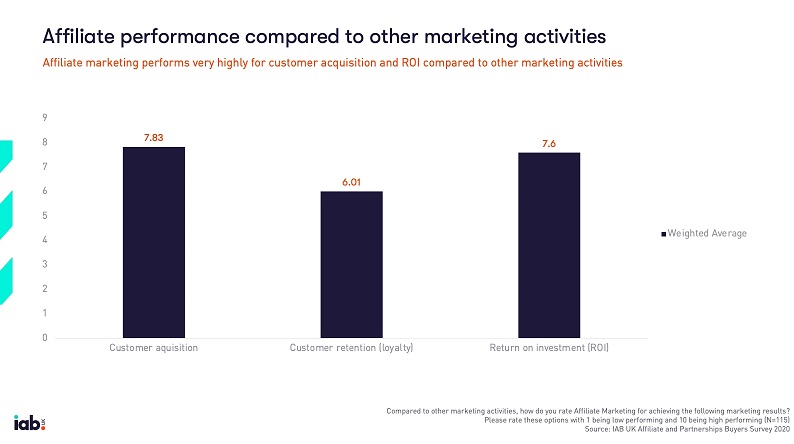
Affiliate marketing software can help businesses collect and analyze the data needed to evaluate the financial contribution of their affiliate programs. However, accurate ROI measurement requires more than tracking clicks and conversions: businesses must also account for the costs associated with generating affiliate-driven results.
A useful assessment should consider:
- Attributed revenue: Sales or other revenue associated with affiliate activity under the selected attribution rules.
- Program costs: Affiliate commissions, platform fees, payment processing, agency fees, and other relevant operating expenses.
- Conversion quality: Whether reported conversions lead to completed purchases, retained customers, or other meaningful business outcomes.
- Partner-level performance: How results differ by affiliate, campaign, offer, and traffic source.
Comparing these figures over consistent periods can help businesses assess whether their affiliate activities are contributing sufficient value. When calculating financial ROI, distinguish revenue from profit and account for applicable costs, refunds, and attribution limitations.
Affiliate marketing software supports this analysis by organizing tracking and reporting data, but the accuracy of the conclusions still depends on the underlying integrations, data quality, and measurement methodology.
Ultimately, businesses should choose capabilities that match their program’s operational and measurement requirements. Our guide to essential affiliate marketing platform features explains the main capabilities to consider, while our affiliate marketing software buying guide covers how to evaluate vendors before making a purchase.